Blog

  • Fall is here and so are we


    After a few quiet months, our November distribution event was busy. We had four volunteers, and an estimate of 80 – 100 friends show up looking for items. 

    We were able to hand out flashlights, socks, gloves, toothbrushes, towels, and our coveted backpacks to everyone. We had some candy, granola bars, soda, and packs of gum as an extra treat. 

    In the somewhat unexpected and smothering humidity, we still were also able to give out pillows, blankets, and winter clothes that were donated from community members in Silver Spring (thank you to everyone who provided), which will last longer than the heat will, and be certainly invaluable for people who may not have a bed to sleep in this winter. 

    We wrapped up the day with a discussion about religion, the government shutdown, and using pantyhose as a disguise, at the local coffeeshop.

    For all non-religious people out there – keep thriving. Our views may not be the most popular among humanity, but rest assured they are firmer, deeper, and older (therefore, more grounded in the history of humans) than any others. 


    See you all next month. 

    AHHDC

     

  • A peaceful morning

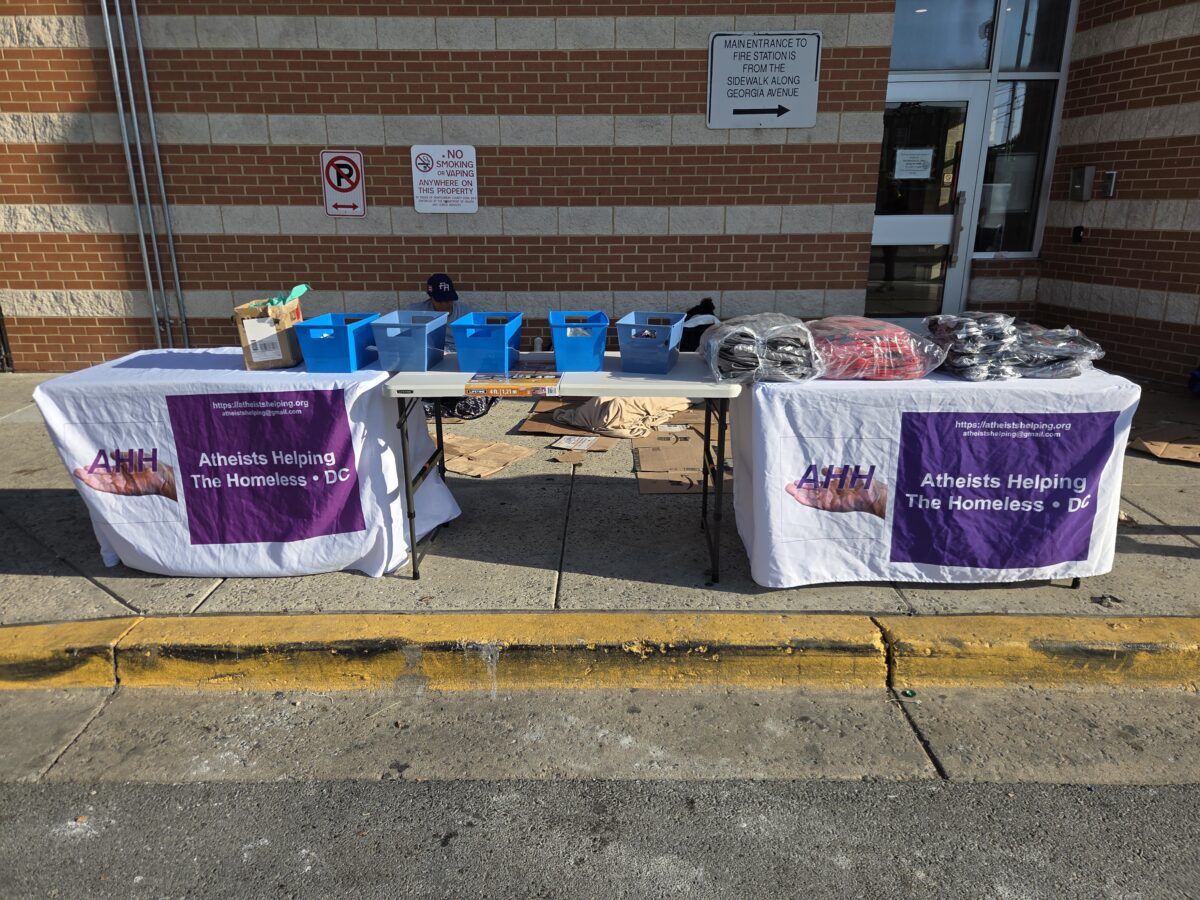
    October 11, 2025 – We had three volunteers today, and served about 40 people, distributing backpacks, flashlights, toothpaste, tooth brushes, hats, socks, gloves, and even had a snack station (thank you sale section at Safeway!). It was a lovely mid-60s, perfect weather to hang outside and chat. 

    As always, our friends who came to get items were wonderfully happy to see us, as we were to see them. As always, many of them told us “God bless you,” wishes we will gratefully accept. Notably, the number of people gathering at Progress Place has been lower in the past few months, for reasons unknown. This may drive us to move to a different location in the future – keep looking here for information, we will update everyone if we go somewhere else.

    For the atheists and humanists out there, the people who are simply not comfortable making conclusions about cause, effect, and meaning in the universe, who are worried about the constant attacks on our worldviews, the juggernaut of Christian extremism that is rolling through the United States, know that there are many others like you, we are family, we are the hope of humanity, and we are unstoppable together. 


                                                                                                                                                Progress Place distribution site, October 2025
  • Brightening a somber fall with a successful distribution

    A Joyful Day


    Hi everyone. We are going to start updating this site every time that we do a handout.


    September saw another wonderful distribution event. We handed out 36 backpacks, a few hundred pairs of socks, 50 or so sets of toothpaste and toothbrushes, and a similar number of small flashlights. Three volunteers showed up at the event. Weather was lovely, the people were all cheerful, and we got to help some people out. Couldn’t imagine a better time. 


    In a not-so-joyful season


    Unfortunately, this comes at a difficult time for those in need in the Washington, DC area. Good news earlier in the year, of a nearly 10% decrease in the homeless population in DC, brought about by reasonable, kind, and helpful policies, have been overshadowed by efforts in the city to forcefully clear encampments of people without permanent homes. Demand for help in our community, needless to say, is still high.


    As is the threat to freedom of thought. Religious liberty, including the freedom to not be religious, is at risk. AHHDC, as one of its core values, opposes any efforts to force belief, including superficial belief represented by participation in rituals or prayer, in the supernatural on anyone, and will not waver in this position. We hope anyone who reads this who thinks the same knows that they are not alone. Take care everyone and enjoy the rest of your September. 


  • HUD Releases 2023 AHAR Data

    HUD Releases 2023 AHAR Data

    653,104 is the number of people who were experiencing homelessness during the national 2023 Point-in-Time (PIT) Count. This figure represents a record high since homelessness data collection began in 2007.

    Homelessness increased overall by 12% from 2022 to 2023.

    46% of older adults experiencing homelessness (age 55 and over) live unsheltered.

    Asian/Asian American homelessness increased by 40% between 2022 and 2023.


    From EndHomeless.Org

  • Food Insecurity Leads To Homelessness

    Food Insecurity Leads To Homelessness

    Buy food or pay bills; that’s a question that many families in America grapple with regularly. When you hear the word food insecurity who immediately comes to your mind?

    For a long time, hunger has been associated with extreme poverty and the homeless. However, a growing lack of consistent access to nutritious meals has everyone talking because it affects more than people experiencing homelessness.

    Poverty and malnutrition form a vicious cycle. One that becomes intergenerational and directly affects a person’s ability to succeed in school and find employment. All of which increases the likelihood that an individual will experience homelessness.

    When you add in the ever-increasing cost of living and lack of affordable housing, a growing concern in many moderate to low-income households. Economic hardship will cause a number of families to accept substandard living arrangements, even homelessness. Individuals will accept underemployment, turn to crime to survive, or sacrifice assets to cover immediate needs.

    As food insecurity rates rise, so will the homeless population. Food insecurity may not be the cause of homelessness, but those who experience it on a regular basis are at a much greater risk of becoming homeless.

    Read More: The Bautista Project Inc

    Photo by Holston Conference


    #atheistshelping

  • Donated Clothing

    Donated Clothing

    Atheists Helping the Homeless DC receives many donated clothes. The items are gently used and are made from materials that don’t need ironing. Our clients can wash them anywhere, even in a sink and they will dry with minimal wrinkles even as they are worn. Knits are good, but some synthetic fabrics are good too (e.g., running pants). In winter we receive jackets, sweaters, gloves, pull-over hats, and more. In spring and summer, we receive light-weight items. Perhaps the most prized items are sneakers. Our people walk everywhere they go, and they need suitable shoes.

    Nextdoor.com is a wonderful resource always helping us to help people experiencing homelessness, and people from that community continue to donate clothing. Nexdoor.com is much appreciated and much needed.

    Our Community Donations Coordinator, Rima Banerjee, makes miracles happen because she always collects for us. For more than a few months, she was responsible for more than half, or nearly all, of our donated clothing.


    #atheistshelping

  • Prevalence of Mental Illness among People Experiencing Homelessness

    Prevalence of Mental Illness among People Experiencing Homelessness

    According to a 2015 assessment by the U.S. Department of Housing and Urban Development, 564,708 people were homeless on a given night in the United States. At a minimum, 140,000 or 25 percent of these people were seriously mentally ill, and 250,000 or 45 percent had any mental illness. By comparison, a 2016 study found that 4.2 percent of U.S. adults have been diagnosed with a serious mental illness.

    Affective disorders such as depression and bipolar disorder, schizophrenia, anxiety disorders and substance abuse disorders are among the most common types of mental illness in the homeless population.

    Most researchers agree that the connection between homelessness and mental illness is a complicated, two-way relationship. An individual’s mental illness may lead to cognitive and behavioral problems that make it difficult to earn a stable income or to carry out daily activities in ways that encourage stable housing. Several studies have shown, however, that individuals with mental illnesses often find themselves homeless primarily as the result of poverty and a lack of low-income housing. The combination of mental illness and homelessness also can lead to other factors such as increased levels of alcohol and drug abuse and violent victimization that reinforce the connection between health and homelessness.

    Studies do show that homelessness can be a traumatic event that influences a person’s symptoms of mental illness. Having ever been homeless and the time spent homeless can be related to higher levels of psychiatric distress, higher levels of alcohol use and lower levels of perceived recovery in people with previous mental illness.

    Read More


    #atheistshelping

  • Dietary Inadequacies Among US Homeless Families

    Dietary Inadequacies Among US Homeless Families

    From and article by R Brown and A Chatterjee:  

    We found that families experiencing homelessness tend to have poor diets, lacking healthy foods such as fruits and vegetables, but high in intake of unhealthy sugars and fats. Barriers to healthy eating included lack of access to cooking and storage resources in the shelter environment, the high cost of healthy foods, and little access to healthy eating options. Interventions to address dietary inadequacies were limited to nutrition education programs, and did not show any significant change in eating behaviors. With the recent increase in family homelessness in several states, namely in the sheltered homeless family population, we propose a need for greater research and interventions that address structural barriers to healthy eating for this underserved population.

    Read More


    #atheistshelping

  • Hunger and Homelessness

    Hunger and Homelessness

    Food Insecurity and Homelessness

    Facing food insecurity impacts our mental and physical health. One study shows that mothers of school-aged children facing hunger are 56% more likely to face PTSD and 53% more likely to face severe depression. There is a strong relationship between hunger and chronic diseases. Food insecurity also changes the way we think and plan. It diminishes our cognitive ability, and food insecurity in youth might even have negative long-term cognitive effects into adulthood.

    The mental and physical health struggles faced by many homeless are even more insidious and the results even more dramatic. Becoming homeless can lead to a serious loss of self-esteem, fear of or actually becoming institutionalized, increase in substance misuse, loss of ability and will to care for oneself, increased danger of abuse and violence, increased chance of entering the criminal justice system, and development of behavioral problems. Homelessness can also lead to cold injury or heat stroke, cardio-respiratory diseases, tuberculosis, skin diseases, nutritional deficiencies, sleep deprivation, new or exacerbated mental Illness, risk for physical and sexual assault, drug dependency and related illnesses, and death.

    The causes of food insecurity and homelessness are complex. Without addressing the emergency need for food, shelter, and care coordination, the problems only spiral and become worse.

    More Reading: Hunger and Homelessness Week


    #atheistshelping

  • The Law Enforcement Response to Homelessness

    The Law Enforcement Response to Homelessness

    Information from a Rand Corporation Study:  

    Police often are the first (and sometimes the only) point of government contact for persons experiencing homelessness (PEH). Although it has been common for police to rely on traditional law enforcement powers in dealing with homelessness, many agencies have moved away from arrest-focused methods in favor of approaches that are designed to foster positive relationships with PEH, assess individual needs of each person or area, and guide homeless or unsheltered individuals to the services they require.

    Police often have limited response options beyond taking people to jail or a hospital. Without the necessary systems to remedy the underlying causes of these frequently co-occurring issues, PEH often cycle in and out of the criminal justice system. Even when resources are available, those in need might consistently decline services.

    Data gathered using a comprehensive research agenda would inform new programs, and ongoing data analysis would help define the nature of homelessness in each jurisdiction, inform solutions to fill gaps or needs left unaddressed by existing responses, and evaluate whether new approaches achieve intended outcomes.

    Photo by Marc A Hermann

    More Reading: The Law Enforcement Response to Homelessness


    #atheistshelping